Mental Health Screenings

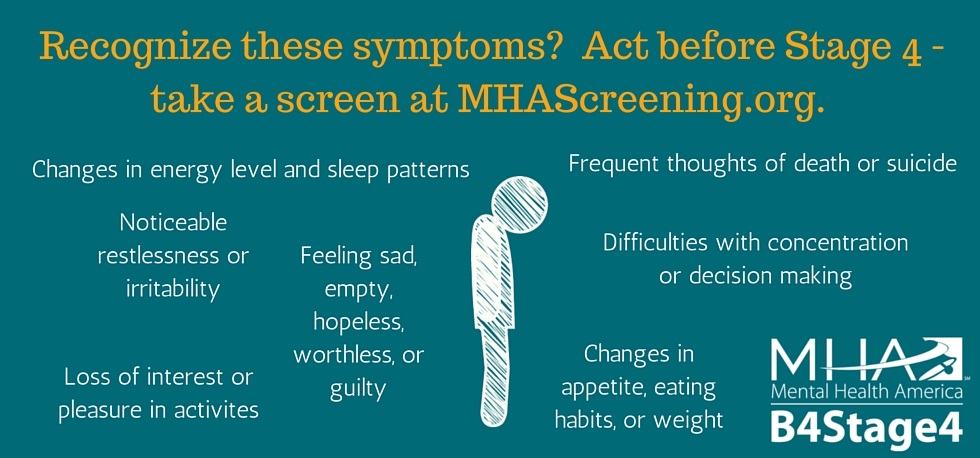
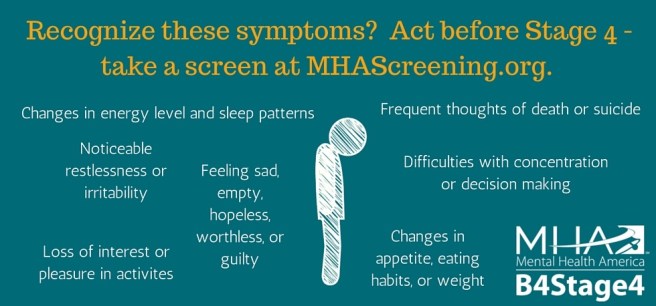
Depression Screen pic 5.20..jpg
Image Courtesy of: Mental Health America 

When it comes to mental health, the first step is elusive for many when speculating that there may be problems developing for themselves. What to do?

It is recommended to go to the family doctor to talk about any issues or feelings that are troublesome. Some symptoms may be medical related, so it is always best to go to your doctor and include them in your recovery journey. The doctor will have guidance on where to begin in the search for treatment.

There are several other sources to augment what the doctor says. For example, in the case of those that want to do self-exploration, and may find it difficult to initially speak to their doctor, or don’t have a current doctor, there are other options.

Nationwide many health related organizations have available tools. One such organization is Mental Health America (MHA). Their Mental Health Screening link is found here.

Follow the information on the page. Resources and suggestions are included. The results of the screening test may rule, in or out, a mental health challenge.

If doing an internet search, “Mental Health Assessment,” and the “name of your town” will bring up local resources, government mental health services, or the recently implemented retail pharmacy treatment centers.

A recent important article related to May being Mental Health Month, is “Walgreens hopes to screen 3 million on mental health by next year” announces that local pharmacies will soon be providing screenings.

Considering the month of May is Mental Health Month, it is a good time to inquire about a screening. Many organizations, local, state, and federal departments are focused on awareness to the public in May and encouraging those interested to take the first step!

Standing in the Way of One’s Own Help

Road Block

There are just about as many ways to get help, as there are methods of help. All of these are need based, and the need is determined at the hands of someone else. Author Todd Essig’s articleHelp for Consumers Shopping the Confusing Online Mental Health Marketplace” written for forbes.com, discusses the complications with relying on online help. The two issues raised in this article are: “There is neither adequate assessment nor professional accountability.” These issues are not only present in the online help platforms available, but also in real life, as people who face mental illness inadvertently stand in their own way.

When it comes to online help, there is no limitation to where a therapist can hold their practice. Without respective boarders, any insurance or protective measures cannot be controlled. Essig illustrates this point in saying “But for now, adequate professional accountability for potentially unethical actions is lacking.” While a therapist may carry good insurance, the insurance is typically only regionally applicable. While regulations and requirements for online treatment are being developed as the process becomes more commonly practiced, there are far too many holes and gray areas to fully ensure that a therapist will be held accountable through a broadly applied online platform.

Unethical action can sometimes be intentional, although it can also be the result of error. In the case of virtual treatment; it may be as simple as a misunderstanding of the patient’s symptoms, or worse, a result of the fact that people can easily edit themselves. Author Joe Madden hits the nail on the head in his article “I tried to Fix my Mental Health on the Internet” when saying “The fact that you can edit messages before sending them means you’re unlikely to blurt out something unguarded and revealing in the heat of the moment.” While online, the editing is in the form of messages, in person, the editing is in the form of personal character. This “editing” is what often makes people their own roadblock from getting adequate help.

When someone decompensates, or has a complete breakdown and loses the ability to control their psychological and physical functions, it is an ultimate low point. They are most certainly not themselves. The typical process is for them to go to the local ER and be assessed. Upon completion of an assessment, they are either sent away with a suggestion to see an outpatient psychiatrist, or admitted to the hospital’s psychiatric department. It is a very different situation if the person does not want help, and a friend, family member, or someone nearby calls 911 for help. The police can utilize a law referred to as 5150 to bring the unstable person to certain psychiatric facilities that have a license for evaluations.  Once a doctor has assessed the patient, they can be admitted with or without their consent on a 72-hour hold. During that time, they are monitored by trained staff, medications may be administered to assist them in regaining stability, and ultimately a plan is put into motion for what will happen after their time in the hospital is up. This is a process that is evidence based and  has been vetted over years of law and regulation development.

With online treatment the person is self determining the severity of their situation, and making decisions on how to be assessed and treated. The instability of an emergency situation can be very dangerous time for self-assessment as perception of reality is very skewed, and clear thinking is essentially impossible. If one is not facing an emergency when seeking online help, they still have the  capability to edit themselves. Editing means censoring their actions and mannerisms before they respond to the online service. The virtual treatment censorship is a two way street, in that the doctor can also sensor themselves and act outside their scope of knowledge. An online atmosphere removes the in person capacity to monitor the patient in real time, and treat them with adaptable evidence based skills.

On one hand, the problem of professional accountability lies more in the hands of virtual treatment that can be complicated waters to navigate on the internet. Debates on regulation and licensing for online services are being developed. On the other hand, the problem of continual assessment applies to both virtual and in person treatment. Self editing and censorship of one’s behaviors presents a huge problem, when the resulting treatment becomes based upon the façade, rather that true reality. Skewed treatment may result in the person being denied access to evidence based programs designed to help them get stable and have long term success in their life.

The above referenced articles evaluate the advantages and dis-advantages of online treatment, while acknowledging that rules and regulations for online help are being developed currently. This presents a buyer beware market. The person seeking help would be wise to explore in person treatment as well online treatment. The severity of their condition should be one of the final determinants of the type of treatment to seek out. It is essential to remember that mental illness is not a one size fits all.The goal should always be to make sure every person who faces a mental illness receives the best possible care for their specific situation.

May is Mental Health Month

GeneralMHFacts- Namil Picture JPEG.jpg
Image Courtesy of: National Alliance on Mental Health

May is National Mental Health Awareness Month

Considering the fact that approximately 1 in 5 adults in the U.S. experience mental illness in one year, and 1 in 5 youth aged 13-18 experiences a severe mental disorder at some point in their life, it is clear that mental illness is a prevalent disease that affects more people than one may think. These statistics also speak for themselves as to the importance of education and resources for both people who face mental illness, as well as those closest to them.

This is the month where many activities are taking place at local, state and federal levels with both in person and online events to learn more about mental illness.

To find out what’s going on in your area, or where the local resources are:

National Alliance on Mental Health (NAMI) with lots of information on May is Mental Health Month including a link to find a NAMI local affiliate.

In California qualifying individuals for government sponsored mental health services for qualifying are provided by counties. The California State Health Department, Mental Health Services Division (MHSD) is an excellent starting point to research for resources in your county.  After locating your county you may find activities during May is Mental Health Month such as Mental Health Screenings and Resource Fairs.

California County Mental Health Plan Contact Numbers

Programs for Adults

Programs for Children and Youth

Resources for Veterans

Police Officer’s Dilemma, Encounters with the Mentally Ill

Police Officer

Police throughout the nation have intensive training before becoming officers. That is as it should be for such a complicated job. What is not very well known is most locals only provide 4 hours of training on encountering the mentally ill.

Mental Illness is such a complex human condition that psychiatrist go three additional years after medical school. The lack of baseline training provided regarding mental illness, is a very discouraging fact, and an unfair allocation of training priorities to police officers. An encounter with a symptomatic person is a challenge with most times a good result. These situations can also get out of control in an instant resulting in outcomes such as arrests, beatings and sometimes death.  Prior to 1988 the norm was for the family and advocates to get outraged, the press to focus on the incident, and then with the passage of time it would fade away, until the next negative encounter.

Fortunately, in 1988 the Memphis Police Department had the foresight to develop at Crisis Invention Training (CIT) that included 40 hours with the goal of creating a jail diversion prior to arrest.  Finally, a police officer who was under trained had a professional focus 40-hour quality training.

Adoption of CIT training across the country has been steady, but not ubiquitous. Being trained in CIT doesn’t guarantee the prevention of a negative outcome, but it does increase the chances of a positive outcome. Studies have shown CIT to be effective.  The infrastructure supporting CIT has grown more professional each year. The future gets better as more CIT officers will be encountering these precarious situations.

Jail diversion and treatment is essential. An act of advocacy for those reading this article is to contact your local NAMI.org affiliate and inquire if the local police department has CIT training. If not, or if the percentage of officers trained is not 100% then ask how you can help. Contact your board of supervisors.

There have been so many recent news stories that have come to the conclusion that the criminal justice system has become the country’s answer to dealing with mental health that it is now common knowledge.  CIT training is one piece of the solution puzzle for assisting this vulnerable population.

While many have claimed that the criminal justice system is the countries answer to mental health at this point, author German Lopez recently published an article examining the true ramifications of the claim. In the article, “How America’s Criminal Justice System Became the Country’s Mental Health System,” Lopez examines several cases where police officers have responded to deal with scenarios of mental illness.

Officers respond to calls involving people who face both diagnosed and undiagnosed mental illnesses every day. It is important to remember what a police officer’s job is when they respond to such a call. When an officer arrives on scene, it is their job to uphold the law, and keep all citizens including themselves safe. Officers do go through extensive training to learn how to make these quick decisions, and what the best case scenario is. At the same time, the basic education they receive does not necessarily pertain to symptomatic mental illness.

When faced with someone who has decompensated and is in a state of complete mental breakdown, there is an immediate need for the officer to regain control to ensure that the person does not hurt themselves or anyone around them. In Lopez’s article, this critical moment in the decision making process is where one of two things occurs, either: “officers blasted him twice with a Taser, shocking him with 50,000 volts of electricity each time,” or “A police officer with training for mental health crisis, approached Kevin…this officer talked softly, reasoned with him, and finally, convinced him to get into the car-no violence necessary.” (vox.com.)  Kevin is the same vulnerable person facing mental illness that went through both of these traumatic experiences.

The first experience of being tased, should not be the norm.  It is the product of a cop making what they considered to be the best decision to regain control. Having a trained officer who responds to the situation with their voice rather than physical action, will go much further in that person’s recovery. Providing officers with education gives them knowledge about various illnesses, and how they may be evident in people’s behavior, as well as the best methods for making quick decisions on how to handle the situation. The proof of how well education works lies in the outcomes.

For Kevin, the person who went through both of the above encounters, it was because of the second officer’s communication and decision to take Kevin to the hospital that he was able to get help. He was able to fight the charges against him at the time, and best of all, “With proper care and medication, Kevin has not had a dangerous run-in with police in nearly 10 years since.” (vox.com) That right there speaks for itself. Kevin has been able to remain in control of himself through care and medication, and has not gotten violent to require police intervention in a decade.

There are thousands of Kevin’s out there, thousands of people who wind up in jail because of the disease they struggle with. These are people who courts deem unfit to stand trial, yet there is nowhere for them to go and not enough education out there to help police officers as they respond to the same call for the same person over and over again.

When a mentally ill person does commit crime, they are responsible.  The solution is treatment before trouble. Through education, programs such as CIT, and the modern therapeutic treatment model, it is possible to allow police officers to do their job more effectively.  By giving them knowledge of how to react to someone who is facing a mental illness, and providing them with tools and supports for where to take the person to get the best help, it is possible to reduce the chances of an immediate repeat situation and ultimately hopefully keep that person from entering the cycle of being in and out of jail.
Homelessness: Beyond a Matter of Choice

Homelesness Graphic
Image Courtesy of: Serge Bertasius Photography, at freedigitalphotos.net


Why would someone choose to be homeless?

There is no one answer to this question. Each person you ask would see their world a little bit differently and give a unique response. The plethora of answers include but are not limited to: drugs, laziness, learned helplessness, victimization, and economic hardship. For many, being homeless is not a matter of choice, but rather a fact of life.

According to the Substance Abuse and Mental Health Services Administration, 20 to 25% of the homeless population in the United States suffers from some form of severe mental illness (SMI). In comparison, only 6% of Americans are severely mentally ill (National Institute of Mental Health, 2009).

Upon researching different forms of SMI, one will quickly discover that most have one thing in common; they impair a person’s ability to complete their basic daily functions.  Gainful employment is often impaired by symptoms, and although some will receive disability benefits; others may fall through the cracks and not know about disability or be too symptomatic to apply. If one cannot complete the basic daily functions such as showering or remembering to eat three meals, how are they supposed to have self-awareness to go out and get access to the programs and services designed to help them survive? Without these programs they lack the basic necessities of a roof over their head, food in their mouths, and reliable medical care.

Food in the life of a homeless person comes from wherever it is available. More important than where the food comes from is what, if any nutritional value. In a society rampant with easy access to junk food, unhealthy foods are much more prominent. Chronic hunger results in getting food to fulfill the need as fast as possible, regardless of what it is. The nutrients that food provides to the brain are key in a chemically balanced person, and critical in a chemically imbalanced person.

If someone cannot regularly access healthy food, they likely don’t receive necessary medical attention or have a reliable place to store their prescribed medications so critical for treatment. Without storage, they are exposed to thieves who take the medication, expiration of the medication when it is not kept in the proper climate, the appeal of selling their medication to have money, or the desire to not take the medication because of the side effects or not believing they have an illness, called anasognosia. All of these realities disturb the normal routine that is fundamental for the medication to be effective. Now, you have an equation of food as an irregular resource that is key for survival, medication that is ineffective without regular dosage, and perhaps most importantly nowhere to rest at night. Irregular sleep is unhealthy and can be a trigger for many symptoms.

Without a secure place to live, homeless must sleep wherever they can. This may include but is not limited to, a local abandoned business building, a park bench, or a local homeless camp. All of these have one thing in common, they are temporary. It is only a matter of time before the public outcry forces police to do something about these types of places. Remember the mental stability piece of the equation as police repeatedly go to these “camps” and warn people that they will be forced to clear the area on a certain date. The likelihood of a. remembering the date, or b. cognitively recognizing what the warning actually means, is little to none. When the day comes that they are kicked out, the question becomes where to go next. The underlying problem is that the cycle is merely starting over, there is no resolution. Sure, one area is clear, but another will quickly pop up as the next makeshift home.

Is there a way to “fix” homelessness?

Although there is not one simple fix, there is a viable starting place. Enter the idea of therapeutic treatment that is based on lasting recovery, rather than temporarily assisting someone to reach a level of stability while still on the street.  If one goes from homelessness to entering a care facility, with access to the right tools to treat their diagnosis and teach them how to live with their diagnosis and complete daily tasks they are capable of, then you have a recipe for success.

Providing a systematic way out of homelessness has proven to be very successful.  The idea of housing first, or getting someone into a stable place to live right away, and then helping them to get other resources such as access to medical care allows for a better chance at getting back on your feet for the long term; rather than being placed in a temporary situation with a high risk that things will go back to the way they were, resulting in being homeless once again.  Often times, a transitional residential program is one of the first steps to teaching life skills to help a person on to a path of recovery and individualized level of achievement for everlasting change, that may very well prevent them from being homeless again.


Alano Club Modesto Event

circle-159252_1280

One of the greatest assets an individual can have in their journey through life is community. A sense of communion or belonging amongst one’s peers allows for simultaneous comfort and growth; as an individual finds their sense of self and develops the realization that they are not alone in the world. Often times, a community of people is based around similar interest or experiences. Having the relatable experiences be positive is a great thing, although it is when the experiences are negative that relatability becomes critical. Whether it be out of fear, embarrassment, or a range of other emotions, people don’t often want to come right out and talk about negative experiences. Having others who have gone through something similar allows one to see not only tangibly see success within other people’s lives, but also to subconsciously start to envision themselves adapting to those same successes in their life.

Two types of experiences specifically related to Ever Well Health Integrated Health Care are substance use issues, and mental illness. There is something to be said for pure relatability amongst people who have shared similar experiences in both of these areas. It is in places such as modern therapeutic treatment communities and Alano clubs that healing and growth are provided within a community setting.

The Alano Club of Modesto has been providing a place for people to go and commune for more than 40 years. In this month’s Stanislaus Magazine, John Black, of the Peer Arts Recovery Project says: “The Club’s managers believe in maintaining its roots as a haven for those who need it as well as a gathering spot for those who want to remain sober and enjoy some great company.” (page 43). All of these gatherings are organized through the efforts of wonderful volunteers. While the club does have a small membership fee, they rely for the majority on donations and fundraisers to be able to cover basic expenses and keep their doors open.

Ever Well is proud to partner with the Peer Art Recovery Project, to host a benefit for the Alano Club of Modesto. The April 16th event aims to provide a night of socializing for community members, while raising funds for a great cause.

What is the relationship between the Alano Club as a sober environment to someone who faces a mental illness?

There is typically a large connection between mental illness and substance abuse as people facing these issues fall on hard times and turn to a variety of sources for escape and comfort. This reaction is not always the case, although it is always the case that places like the Alano Club that allow for people to thrive. Just like kids like to join sports teams with their friends, or adults join things such as book clubs, people who face mental illness, or have substance use issues alike need a place to convene to socialize and celebrate their accomplishments. The Alano club offers this space with people who have had similar experiences in their lives. As John mentions in his article, people who previously turned to alcohol or drugs to escape or celebrate, now have a way to celebrate their accomplishments in a safe, sober place.

As people spend time at Ever Well getting the tools they need to build a stable life, it is important for their program activities to include introductions to places such as wellness centers and Alano clubs so that wherever that person may end up, they will know how to reach out to develop a community to be continually reminded that they are not alone. The sense of belonging and comfort astronomically improves one’s chances of staying on a clean stable path to have a great life. We at Ever Well value the opportunity to support an organizations like the Modesto Alano Club and The Peer Arts Recovery Project to ensure the gift of community and sobriety for many years to come.

If you or someone you know is facing a mental illness or substance use issue in Central California, please contact the Peer & Family Advocate at: (209) 543-2425

To support recovery efforts in the Central Valley click here.


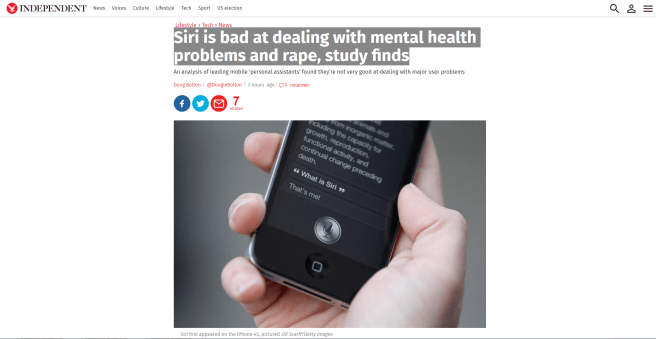
Siri Doesn’t Have an Answer


dafdfdafd
Original Article: http://www.independent.co.uk/life-style/gadgets-and-tech/news/siri-physical-mental-problems-health-voice-assistants-a6932891.html


A recent study conducted in partnership by Stanford University, and The University of California found that while smartphone voice assistants have become very popular, they are rather inadequate when it comes to offering help to people in crisis. During the study, several statements were said to the various smartphone platform voices, and very little useful information was repeated back by the voices. To better demonstrate, the article states, “In fact, very few of the services could help distressed users apart from in cases of suicide or physical injury- Siri directs users to the emergency services or nearby health centers if it detects they’re reporting health problems, but it can’t differentiate between ‘I’m having a heart attack’ and ‘my foot hurts’.” This is problem when considering the article’s mentioned statistic that 62% of Americans refer to their cellphones for information regarding health.

If these voice response systems have the capability to quickly search databases yet can’t return an answer to the consumer, imagine the time a family member could spend searching the databases themselves while still not getting any answers. Without experiencing the symptoms for themselves, a family member approaching the topic for the first time is probably going to find their research to be about as informative as Siri’s answer. The incapability of a smartphone voice’s response regarding topics such as mental illness, indicates not only a problem with the technology per say, but also an example of how the resources within the online community can be muddled. In a situation where the spectrum of symptoms is as wide as the multitude of diagnosis, getting on the right path towards help is not easy. Whether it be the individual facing the illness themselves, or family and friends seeking help, the abundance of resources can prove to both help and hinder the process.

If you or a family member needs help, please call the national mental health association: 1-800-969-6642.


Schizophrenia’s Future in Connection to the C4 Gene

Schizophrenia

Schizophrenia by definition: According to the Surgeon General’s Report titled Mental Health, “Schizophrenia is characterized by profound disruption in cognition and emotion, affecting the most fundamental human attributes: language, thought, perception, affect, and sense of self. The array of symptoms, while wide ranging, frequently includes psychotic manifestations, such as hearing internal voices or experiencing other sensations not connected to an obvious source (hallucinations) and assigning unusual significance or meaning to normal events or holding fixed false personal beliefs (delusions).” (Page 269-270).

A January 29th CNN story covered the topic of a recent research discovery regarding schizophrenia, which we are using for this article to bring awareness to promising news. The article states: “This new study’s hypothesis is that people with schizophrenia have a variation of a gene called C4 that creates two varieties of proteins: C4-A and C4-B. Looking at the genes of 64,000 people, those who struggled with schizophrenia had C4 genes that produced overactive forms of the C4-A protein.”

What does that mean exactly? What the research suggests is that people with schizophrenia who carry these genes have a problem with a natural process in the brain called “synaptic pruning”. The gene C4 is also involved with regulating the immune function. The brain has cells that act like a cleaner to help the brain get rid of clutter. As one develops and learns things, these cells remove the redundant or weak connections between synapses. Synapses are like intersections on roads that carry information through the brain. After a good street cleaning, what’s left behind are clearer intersections and stronger, healthier connections.

Do this study’s findings mean a cure is in sight? Unfortunately, not exactly. It does bring scientists closer to treatment improvements. While should not be discounted that schizophrenia is a very complicated disease with much to learn still; there is a real victory here in considering that as more research is completed, it is a possibility that one-day schizophrenia may not disrupt people’s lives to the point that they cannot function. This is fantastic forward progress when considering what schizophrenia can be observed as in the public in this day and age.

The Schizophrenia that the public observes could be: That person passed walking down the street today who is carrying on a complete conversation with themselves. A person with these symptoms is often avoided by individuals or parents being protective of their children to the point of scurrying to the other side of the sidewalk, tightly holding their child’s hand, and reminding them to stay away from strangers. On another occasion, maybe there was a person standing in the middle of a busy intersection as you wait for the stoplight to go from red to green. Would you believe that a distortion of reality, in the form of voices in one’s head, told them to stand there?

Would you accept the fact that those same voices convinced that person to not eat last night’s dinner because it was poisonous? Even more relevant, consider the fact that the very same voice alienated that vulnerable person from life around them. In reality, these people are in a fragile state of illness and have yet to receive the help they need. According to CNN’s article, “The World Health Organization estimates that one in two people living with schizophrenia do not get any treatment.” Lack of treatment can result from not being diagnosed, or lack of adequate resources, both issues which can hopefully be amended as new knowledge is found about the C4 gene and its relationship to schizophrenia.

The Mayo Clinic claims on their information page for schizophrenia that: “Schizophrenia is a chronic condition, requiring lifelong treatment.” Of course this is not a newly discovered disease, there are thousands of treatment options out there, although not one specific treatment that works every single time. With a recent study completed, there is a renewed sense of energy being invested to complete more testing, which can only improve the treatment models.

How do these people begin to get help? Family, friends and advocates cannot necessarily go and talk about how the voices aren’t real; considering the person’s version of reality indicates there is no help needed.  Instead, they will either live in a disordered life of instability that is controlled by possible voices and hallucinations; or potentially get picked up by local police for disturbance of the peace, in turn worse if they have committed a crime at the will of the voices. There is a substantial chance that the person will go into the justice systems as just another criminal. In the best case scenario, the police will will see they pose a threat to themselves, or others, resulting in the order of a 5150, which means being admitted to a psychiatric hospital to be observed for 72 hours, then get help. For that smaller number of people that get the chance to receive help, current treatment methods such as transitional housing and medication, are only the beginning; just at the discovery of the C4 gene’s connection to schizophrenia is to finding improved treatment methods.

While people can continue to use the supports and services that currently exist, scientist now have a better grasp on possible starting points to examine schizophrenia in future studies. In truth, this study brings a new light to the improvement of schizophrenia diagnosis and treatment in the real world.

References

Christensen, Jen. “Discovery One Step Closer to Cause of Schizophrenia- CNN.com.” CNN. Cable News Network, 29 Jan. 2016. Web. 29 Jan. 2016

Mayo Clinic Staff. “Schizophrenia.” www.mayoclinic.org. Mayo Clinic, 24 Jan. 2014. Web. 29 Jan. 2016.

U.S. Department of Health and Human Services. Mental Health: A Report of the Surgeon General. Rockville, MD: U.S. Department of Health and Human Services, Substance Abuse and Mental Health Services Administration, Center for Mental Health Services, National Institutes of Health, National Institute of Mental Health, 1999. http://profiles.nlm.nih.gov/ps/access/NNBBHS.pdf Web. 1 Feb. 2016